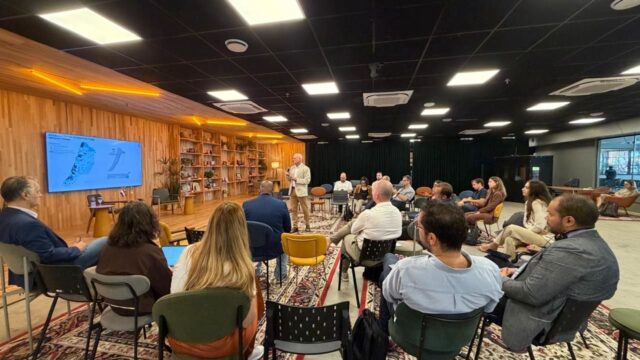
The Water Agency recently participated in the Brazil-Netherlands Water & Climate Resilience Fact-Finding Mission, with Managing Director Gregor van Essen and Project Consultant Ana Clara Cassanti joining a delegation of Dutch organisations, research institutes, and public-sector representatives exploring opportunities for collaboration across Brazil’s water and climate resilience sector. The mission brought participants to São Paulo and Porto Alegre, facilitating exchanges with utilities, regulators, research institutions, government agencies, and local stakeholders working at the forefront of water management and climate adaptation.
Organised by the diplomatic network of the Kingdom of the Netherlands in Brazil, the mission aimed to strengthen partnerships between Brazil and the Netherlands around water governance, climate adaptation, flood resilience, and sustainable infrastructure. Through a series of meetings, technical exchanges, site visits, and networking events, participants explored shared challenges and opportunities for cooperation in building more resilient water systems.
In São Paulo, discussions highlighted a strong institutional landscape, with utilities, regulators, and research institutes actively advancing the water resilience agenda. At the same time, conversations pointed to an important challenge: translating existing strategies, knowledge, and investments into scalable and implementable solutions that deliver impact on the ground. The contrast was particularly evident in Porto Alegre, where the impacts of the devastating 2024 floods remain highly visible. Alongside significant reconstruction efforts and a large pipeline of resilience projects, local stakeholders expressed a strong sense of urgency and openness to new approaches related to flood resilience, monitoring, adaptive infrastructure, and long-term climate preparedness.
For The Water Agency, the mission reinforced two key reflections. First, Brazil represents a significant opportunity for deeper collaboration between Dutch and Brazilian partners. As investments and initiatives continue to accelerate, there is growing value in coordinated approaches that combine public and private expertise, practical innovation, and long-term implementation support. Secondly, while large-scale infrastructure and system-wide investments remain essential, there is also considerable potential in community-level action. Pilot projects, participatory design approaches, and local engagement initiatives can play a vital role in informing and accelerating broader resilience strategies. These reflections closely align with The Water Agency’s approach to water resilience: connecting local action with system change and transforming partnerships into implementation. As climate challenges become increasingly complex, meaningful collaboration across sectors, disciplines, and geographies will be essential to building resilient communities and water systems.
The Water Agency extends its thanks to all Brazilian partners, institutions, and mission organisers for their openness, insights, and hospitality throughout the programme. We look forward to continuing the conversations initiated during the mission and exploring opportunities to support water and climate resilience efforts across Brazil.